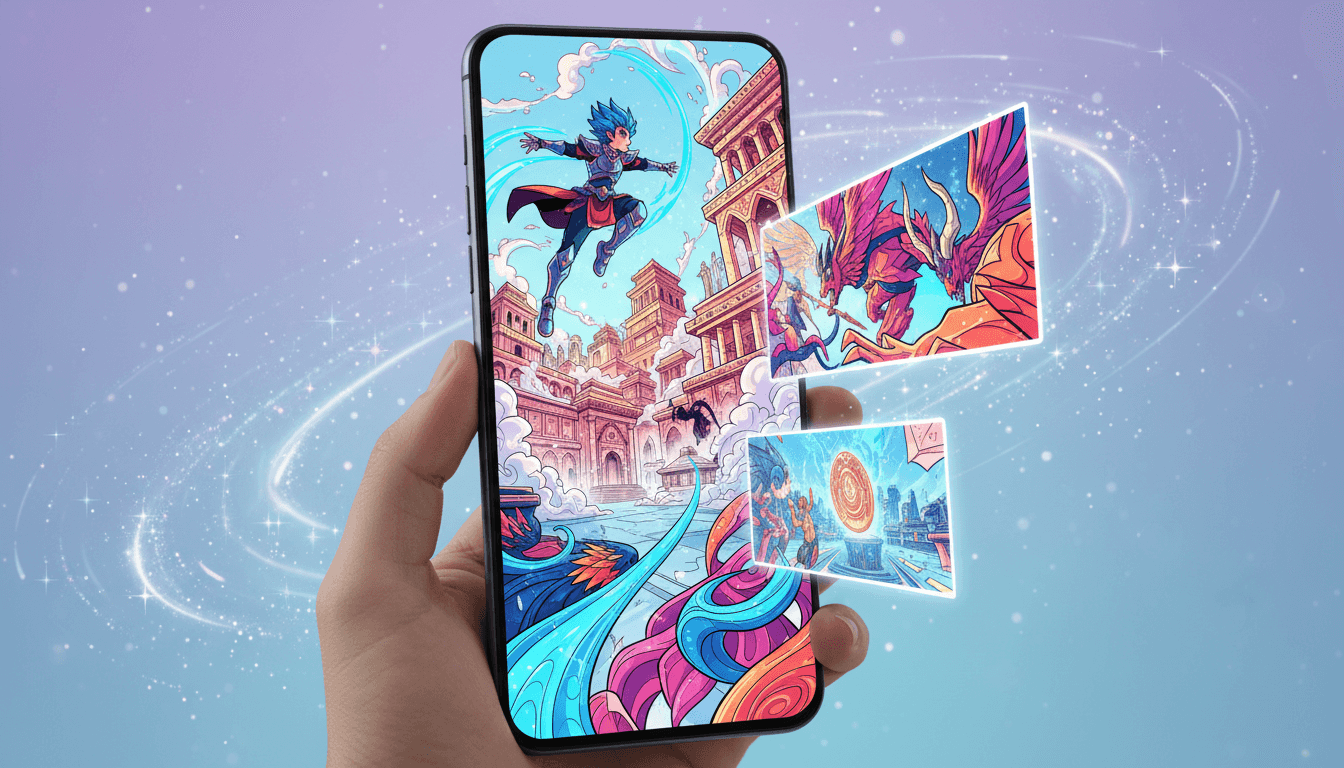
Webtoons have quietly become the dominant force in digital comics. While traditional comics and manga still thrive, the vertical scroll format born in South Korea has exploded into a global phenomenon — with over 170 million monthly active readers worldwide and a market projected to exceed $50 billion by 2030. Platforms like LINE Webtoon, Tapas, and Tappytoon have turned solo creators into millionaires, and webtoon adaptations now regularly become hit K-dramas and anime series.
The appeal is simple: webtoons are designed for how people actually read today — on their phones, scrolling vertically, one panel at a time. No page turns, no two-page spreads to squint at on a small screen. Just fluid, immersive visual storytelling optimized for the device in your pocket. And with AI webtoon creation tools, you no longer need to spend weeks drawing a single episode. Here's everything you need to know about the webtoon format and how to create your own with AI.
What Makes Webtoons Different
Webtoons aren't just "comics on a phone." The format has its own storytelling conventions, visual techniques, and creative rhythms that make it a distinct medium. Understanding these differences is essential for creating webtoons that feel authentic.
Vertical Scroll Format
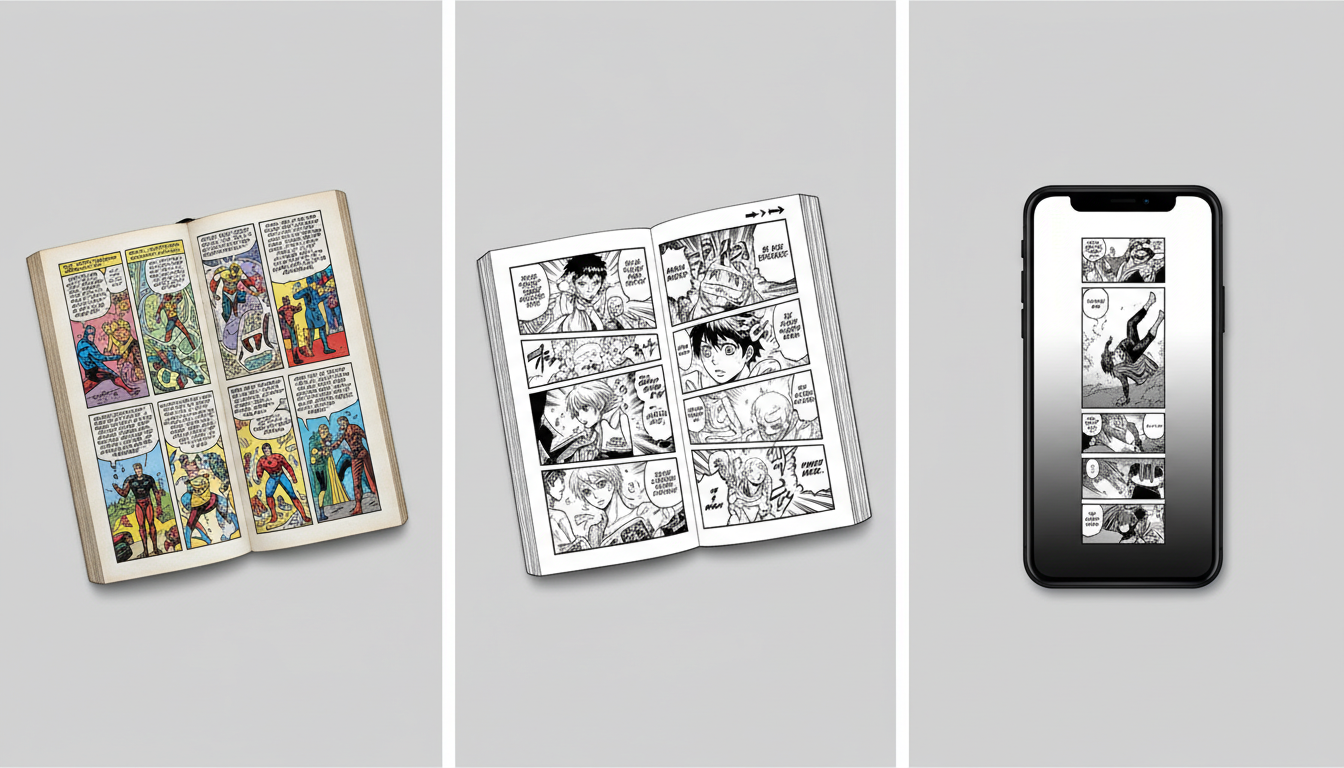
The defining characteristic. Traditional comics and manga use pages with multiple panels arranged in a grid. Webtoons use a single continuous vertical strip — readers scroll down through panels that stack on top of each other. This creates a fundamentally different reading rhythm: slower reveals, longer dramatic pauses, and a natural pacing controlled by the reader's scroll speed.
One Panel at a Time
In traditional comics, your eye can scan an entire page and accidentally see a surprise panel before you read to it. Webtoons eliminate this problem. Each panel is revealed sequentially as the reader scrolls, giving creators precise control over pacing, reveals, and dramatic moments. A character's shocked expression can take up the entire screen width, creating impact that's impossible in a multi-panel page layout.
Full Color as Standard
While manga is traditionally black and white, webtoons are almost always in full color. The digital-first format embraces vibrant coloring, soft gradients, and atmospheric lighting effects. The webtoon art style is characterized by clean digital coloring with smooth shading — distinct from both manga's screentone aesthetic and Western comics' heavier color approaches.
Episode-Based Serialization
Webtoons are released as episodes (typically weekly), with each episode being a self-contained experience that advances the overall story. Episodes usually have 50-80 panels and take 3-7 minutes to read. This episodic structure creates perfect hooks for reader retention — end each episode with a cliffhanger or emotional beat that makes readers come back next week.
Webtoon vs Manga vs Traditional Comics
Each comic format has its strengths. Understanding the differences helps you decide whether webtoon is right for your story:
- Format: Webtoon is vertical scroll | Manga is right-to-left pages | Western comics are left-to-right pages
- Color: Webtoon is full color | Manga is traditionally B&W | Western comics are full color
- Reading device: Webtoon is phone-optimized | Manga works print and digital | Western comics are print-optimized
- Pacing: Webtoon uses slow reveals via scroll | Manga uses dynamic page layouts | Western comics use grid-based progression
- Art style: Webtoon has clean digital coloring | Manga uses screentones and ink | Western comics use heavy inking and coloring
- Release: Webtoon releases weekly episodes | Manga serializes in magazines | Western comics are monthly issues
- Demographics: Webtoon skews young and female | Manga covers all demographics | Western comics skew male and older
The biggest advantage of the webtoon format is accessibility. Nearly everyone in the world has a smartphone, and vertical scrolling is the most natural mobile interaction. This is why webtoons are growing faster than any other comic format globally.
Why AI Changes Everything for Webtoon Creators
Traditional webtoon creation is grueling work. Professional webtoon artists typically work 60-80 hour weeks to produce a single weekly episode. Each episode requires backgrounds, character art, coloring, shading, effects, and lettering — all in full color. Even with digital tools and assistants, it's one of the most labor-intensive art forms.
This is exactly why AI is revolutionary for webtoon creation:
- Solo creators can compete. Previously, producing a weekly full-color webtoon required a team (artist, colorist, background artist, letterer). AI lets a single person generate professional-quality episodes.
- Speed without sacrificing quality. What takes a human artist 40-60 hours per episode can be generated in minutes. This doesn't mean AI replaces artistic vision — it means creators can focus on storytelling while AI handles the production workload.
- Experimentation is free. Try different art approaches, test story ideas, and explore visual styles without committing days of drawing time. If an episode doesn't work, regenerate it.
- Character consistency. One of the hardest aspects of ongoing webtoons is keeping characters looking the same across hundreds of panels. AI maintains character consistency automatically, solving one of the biggest challenges in serialized visual storytelling.
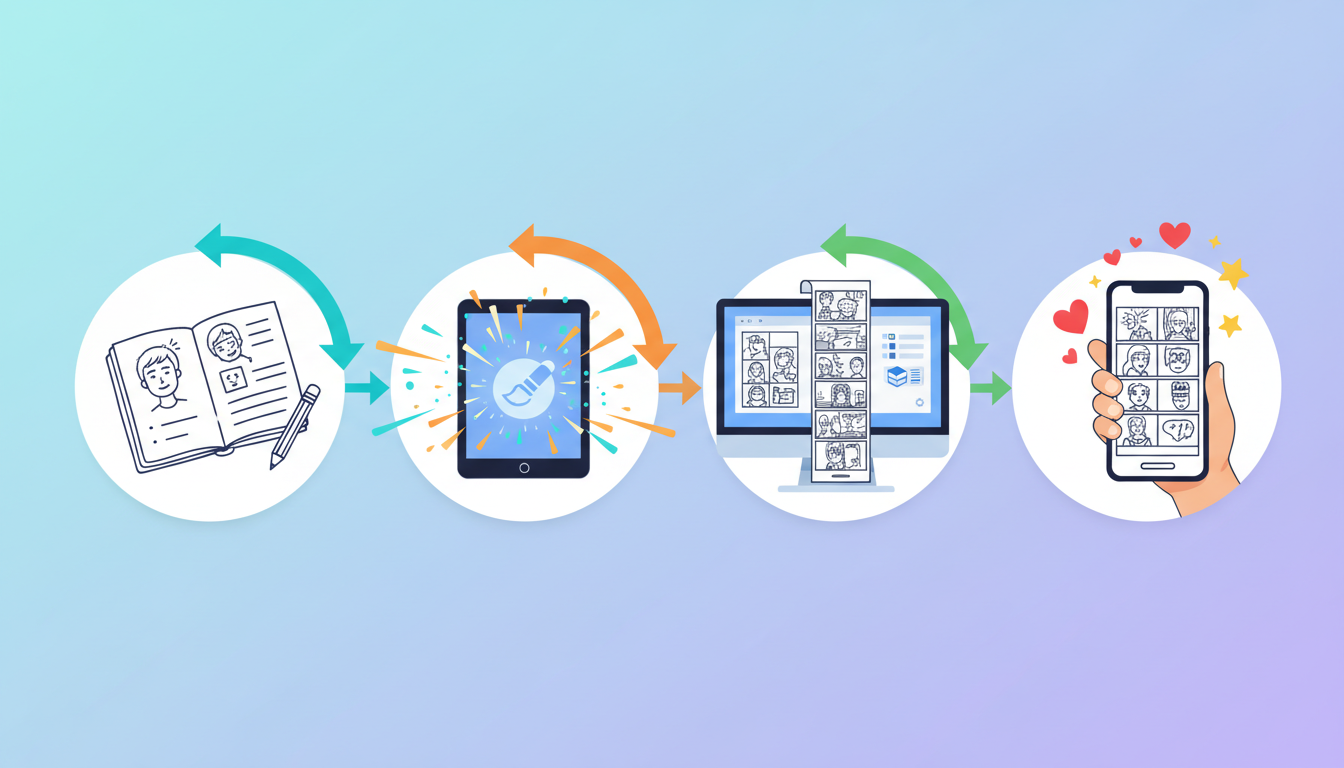
Complete Webtoon Creation Workflow with AI
Step 1: Plan Your Episode
Great webtoons start with great stories. Before generating any art, outline your episode:
- What happens in this episode? (main plot beat)
- What's the emotional arc? (how should readers feel at beginning, middle, end)
- What's the hook? (cliffhanger or emotional beat for the ending)
- Key scenes: list 4-6 major scenes that make up the episode
Step 2: Write Scene Descriptions
For each scene, write a brief description that includes the setting, characters present, actions, emotions, and dialogue. Be specific about visual details — AI works best with concrete descriptions. Instead of "they talk," write "Maya leans against the railing of the school rooftop, avoiding Joon's eyes as she says goodbye."
Step 3: Choose Your Art Style
Select the Webtoon style in iCartoon's AI Comic Creator. The webtoon style features the clean digital coloring, soft shading, and polished character designs that define the format. You can also explore adjacent styles: Anime for a more Japanese-influenced look, or Manga if your story leans more toward that aesthetic.
Step 4: Generate and Review
Generate your episode. Review each panel for consistency, emotional impact, and narrative flow. Regenerate any panels that don't match your vision. Pay special attention to character expressions — emotion is the currency of webtoons, and every face should clearly communicate how the character feels.
Step 5: Polish and Publish
Review dialogue, check pacing, and ensure the episode flows smoothly from top to bottom. The last panel should make the reader desperate for the next episode. Save your creation and share it.
Webtoon Storytelling Techniques
The vertical scroll format enables storytelling techniques that don't exist in other comic formats. Master these for authentic webtoon storytelling:
The Dramatic Scroll Reveal
Place a dramatic reveal (a character's face, a shocking scene, a key object) just below the current screen view. The reader scrolls down and — boom — the reveal hits with full impact. This is the webtoon equivalent of a page-turn surprise, but more controlled because you know exactly when the reader will see it.
White Space as Pacing
In webtoons, empty space between panels controls reading speed. More white space = slower, more contemplative pacing. Panels stacked tightly = fast, urgent pacing. A single panel surrounded by generous white space demands the reader's attention and creates a powerful pause in the narrative.
Full-Width Emotional Panels
When a moment is important — a confession, a betrayal, a beautiful landscape — give it the full screen width. Let the panel breathe. This is the webtoon version of a full-page spread, and it's incredibly effective for key emotional moments.
Scrolling as Passage of Time
The physical act of scrolling can represent the passage of time. A series of small panels showing a character walking, with gradually changing scenery, creates a sense of journey and time passing that feels organic because the reader is physically moving through the content.
The Cliffhanger Ending
Every episode should end with a hook. In webtoons, the most effective hooks are visual: a mysterious figure appearing in the background, a character's expression changing from happiness to shock, or a dramatic scene cut off mid-action. The reader has to wait for the next episode — and that waiting is what builds devoted audiences.
Character Consistency in Webtoon Series
One of the biggest challenges in creating an ongoing webtoon is keeping characters recognizable across dozens of episodes and hundreds of panels. AI tools help significantly with this, but here are additional tips:
- Define character traits clearly. When describing characters, include specific visual details: hair color and style, eye color, distinctive clothing, accessories, and body type. The more specific you are, the more consistent the AI's output.
- Use reference images. If your character is based on a real person, use photo-to-comic conversion to establish the character design, then describe that design consistently in subsequent episodes.
- Keep wardrobe consistent. In webtoons, characters often have signature outfits (like Naruto's orange jumpsuit or Luffy's straw hat). Give your characters a recognizable default look that appears in most episodes.
- Maintain style continuity. Stick with the same art style across all episodes. Switching styles between episodes breaks immersion and confuses readers.
Start Your Webtoon Today
Create professional webtoon episodes with AI. Full color, consistent characters, and vertical scroll format.
Create Your First Episode →Popular Webtoon Genres
Certain genres thrive in the webtoon format. If you're choosing what kind of webtoon to create, consider these proven categories:
- Romance — The dominant webtoon genre globally. Slow-burn romances, love triangles, and "will they / won't they" dynamics are perfectly suited to the weekly episode format.
- Fantasy romance — Combine romance with isekai (transported to another world), reincarnation, or magical settings. Massively popular in the webtoon ecosystem.
- Slice-of-life — Everyday stories about friendship, family, school, and growing up. The intimate, personal nature of the vertical scroll format makes slice-of-life feel especially immersive.
- Action/adventure — Martial arts, superpowers, dungeons, and epic battles. The vertical scroll allows for dramatic action sequences that unfold as the reader scrolls through impact moments.
- Thriller/mystery — Suspenseful stories benefit enormously from the scroll reveal technique. Each scroll can reveal a new clue or shocking twist.
- Comedy — Short-form comedy webtoons with gag-per-episode structure are great for beginners. Each episode is self-contained, reducing the pressure of complex ongoing plots.
Publishing Your Webtoon
Once you've created your episodes, where do you publish? Here are the main platforms:
- WEBTOON (Naver/LINE) — The largest platform with over 80 million monthly active users. Canvas section is free to publish on. Most visible audience but also most competitive.
- Tapas — The second-largest English-language platform. Strong community features and monetization options for creators. Tends to have a more indie-friendly culture.
- Social media — Instagram, TikTok, and Twitter are increasingly popular for sharing webtoon panels and episodes. Good for building an audience before publishing on dedicated platforms.
- Your own website — Full control over presentation and monetization. Platforms like WordPress with comic-specific themes support vertical scroll format.
Frequently Asked Questions
Do I need to draw to create a webtoon?
No. AI webtoon creators like iCartoon generate professional-quality webtoon art from text descriptions. You provide the story and creative direction — the AI handles the visual production. Creating comics without drawing is easier than ever.
How many panels should a webtoon episode have?
Professional webtoons typically have 50-80 panels per episode, taking 3-7 minutes to read. For AI-created webtoons, starting with 20-30 panels (6-10 pages) is a good balance of substance and manageable scope. You can scale up as you develop your workflow.
What's the best genre for a first-time webtoon creator?
Slice-of-life and comedy are the most forgiving for beginners. They don't require complex world-building, can work with shorter episodes, and let you focus on character and emotion — the core strengths of the webtoon format. Romance is the most popular genre if you're targeting an audience.
How often should I release new episodes?
Weekly is the standard for professional webtoons. However, for a solo creator using AI, biweekly or even monthly releases are perfectly acceptable. Consistency matters more than frequency — readers prefer a reliable schedule over sporadic releases.
Can AI maintain character consistency across multiple episodes?
Yes. Modern AI comic tools maintain character appearance across panels and pages. When creating a series, use consistent character descriptions and the same art style to ensure your characters look recognizable throughout the entire run.
The webtoon format is the future of digital comics — designed for phones, optimized for scrolling, and loved by hundreds of millions of readers worldwide. With AI tools removing the production barrier, the only thing standing between you and your own webtoon series is a good story. And everyone has one of those. Start creating your webtoon today.